

Artificial intelligence has made it easier than ever to create logos, graphics, and design ideas in just a few seconds. We get why people use it. It’s fast, it’s easy, and it can be a fun way to start building a concept.
At Pro Image Design, we’re totally open to customers bringing us AI-generated ideas. In fact, they can be a great starting point. But it’s important to know that what looks good on a screen isn’t always ready for the real world.
One of the biggest issues is that AI-generated artwork usually isn’t built as clean vector art. Most of the time, it’s just an image made of pixels. That may work fine for looking at on your phone or computer, but when it comes time to reproduce it on signs, apparel, vehicle graphics, print materials, or other products, it often has to be redrawn or recreated. That extra cleanup can add time and artwork cost.
Color can also be a challenge. A design might look great on one background in an AI sample, but then not work at all on another. Maybe it looked sharp on black, but disappears on white. Maybe the colors felt bold on a screen, but don’t translate well in vinyl, ink, paint, or thread. A design has to work across a lot of different surfaces and materials, and AI doesn’t always think that far ahead.
Sometimes AI artwork is a little like those pictures where everything looks normal at first… until you notice the hand has six fingers. At a glance, it seems polished. But when you slow down and really look at it, the problems start to show. In design, that might mean odd spacing, distorted text, uneven lines, awkward shapes, or details that just won’t reproduce well. It may look finished, but it still takes a human eye and real experience to spot what’s off.
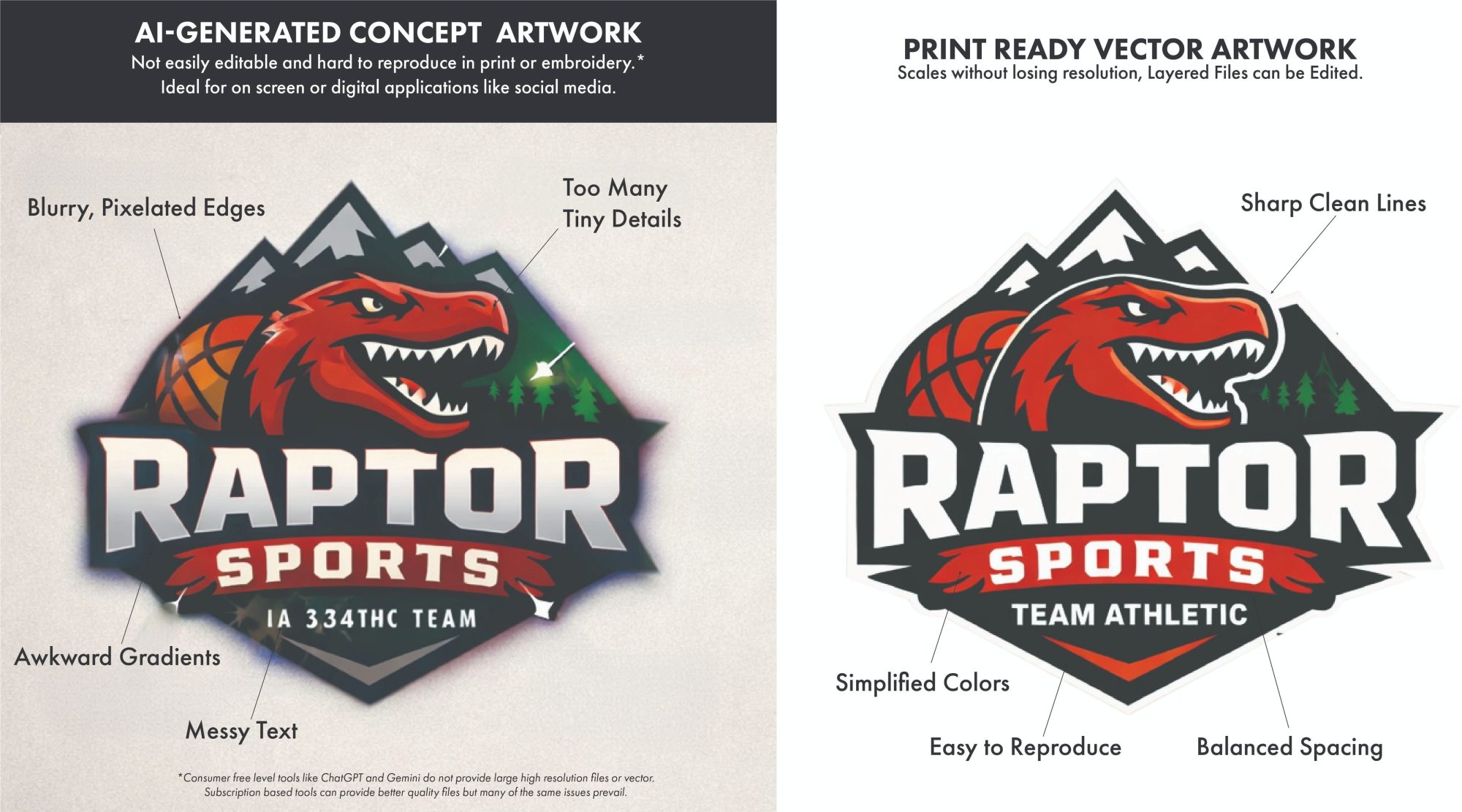
Another thing to keep in mind is that AI often creates effects that don’t always translate well into production. Glows, shadows, gradients, distressed textures, and tiny details can be tricky or even impossible to reproduce depending on the medium. What works in a digital mockup may not work on a routed sign, embroidered apparel, a vinyl decal, or a large-format print.
There’s also the branding side of it. A design might look cool on its own, but that doesn’t necessarily mean it fits your business, your message, or your long-term brand. A strong design needs to work everywhere — on your building, your truck, your business cards, your shirts, and your social media. That kind of consistency still takes thought, experience, and sometimes a little reworking.
The bottom line is this: AI can be a great tool for inspiration, but it should usually be treated as a starting point, not final artwork. We’re happy to work with customers who use AI to explore ideas. We just want people to understand that bringing in an AI-generated design often still means professional cleanup, adjustments, or even full recreation before it’s ready to reproduce properly.
Because in the end, good design isn’t just about looking good at first glance. It’s about working in the real world.


