

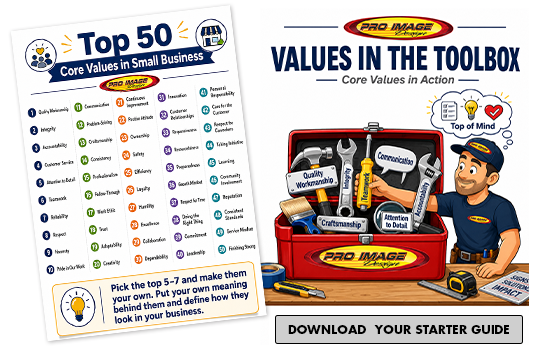
Many businesses know they should have core values, but figuring out where to start can be difficult. The purpose of this article is to share a practical way to begin that process — not by copying someone else’s values, but by identifying what already matters most inside your own company.
Core values are more than words on a wall. They are the beliefs that guide how a company makes decisions, treats customers, solves problems, and works together as a team.
The best core values are not created by simply choosing words that sound good. They should come from the real culture of the business. Start by looking at what already exists. What behaviors are praised? What qualities do your best employees show? What do customers appreciate most? Often, the strongest values are already showing up every day through hard work, teamwork, attention to detail, and pride in the finished product.
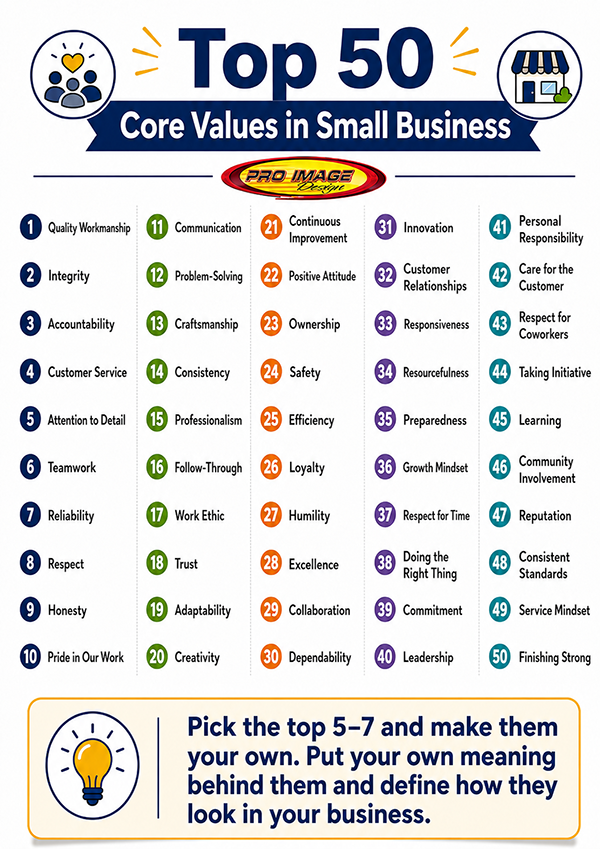
Once those values are identified, they need to be clear and practical. A value like “quality” becomes much stronger when it is defined in a way people can understand and apply. A good core value should answer the question, “What does this look like in our daily work?”
Staff participation is also a key part of the process. Employees are more likely to support core values when they have had a voice in shaping them. Asking the team what they believe the company stands for, what behaviors they respect in coworkers, and what standards should represent the business helps create buy-in. The values become a shared agreement, not just a set of rules from leadership.
After the values are created, they need to be used often. They should be part of hiring, training, staff meetings, employee recognition, and problem-solving. Recognizing real examples of employees living out the values helps make them memorable and meaningful.
Most importantly, leadership has to live the values first. If a company says it values quality, teamwork, or attention to detail, those standards must be supported and modeled from the top down.
When core values are developed honestly, shaped with staff input, and reinforced consistently, they become much more than a statement. They become the foundation for a stronger culture, better decisions, and a team that understands what the company truly stands for.


